
By Gary Harvey
Business Development Director, Building Solution Integrations
[3 minutes]
Welcome to another in a series of blogs exploring the real-world applications of Delta's DIATwinTM digital twins! Manufacturing is shifting from validating products to continuously learning from them.
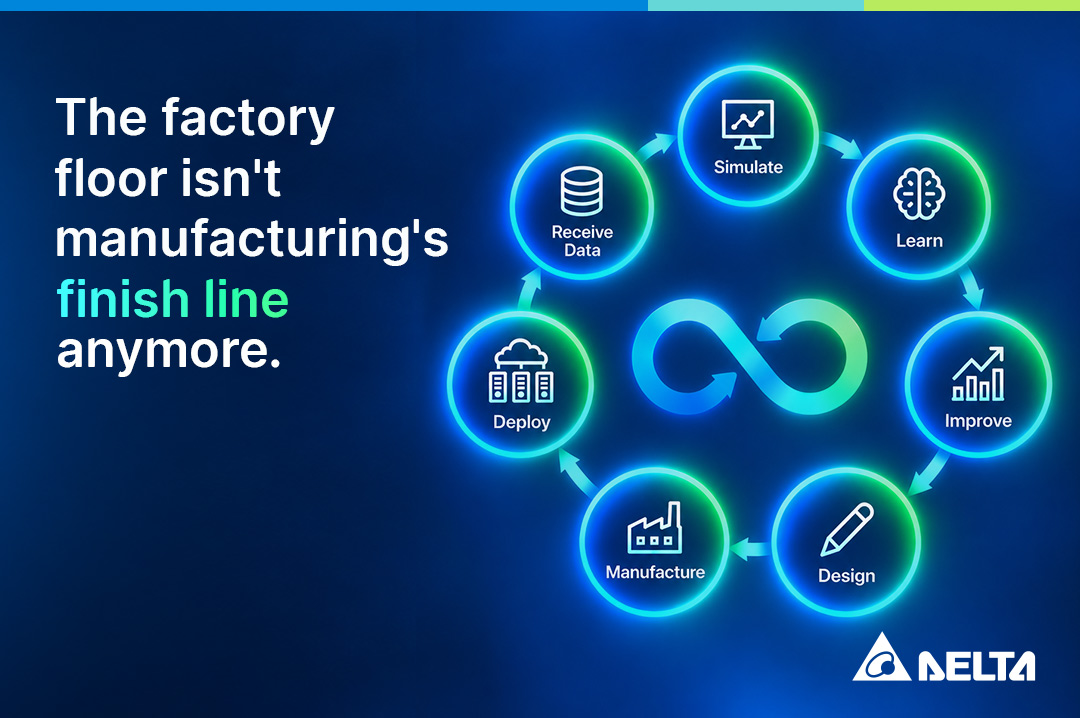
Manufacturers are now able to connect data from products in the field back to their engineering, quality, and production teams, using real-world performance data to turn production validation from a one-time checkpoint into a continuous feedback loop. This loop improves product performance, surfaces emerging issues, and informs future production decisions.
So the factory floor no longer has to mark the end of the manufacturing process. Instead, as products grow more connected and intelligent, what happens after deployment could carry as much value as what happens during production.
Using Field Data for Continuous Learning
Field performance data creates a new model for product validation.
Connected products give manufacturers visibility into the real-world variables—usage patterns, temperature, load, and maintenance conditions, and more—that are difficult to replicate on a production line and which all impact performance over time.
Collecting and analyzing operational data reveals how products perform beyond the factory and surfaces patterns that initial validation may not show, strengthening engineering decisions, refining production processes, and improving future product generations.
Traditional validation, such as testing, inspection, and quality control, is still essential to confirm a product meets its specifications before leaving the factory. But it provides only a snapshot of performance under controlled conditions.
Connecting the Physical and Digital Worlds
A connected digital foundation makes the above feedback loop possible, bringing together information from equipment, products, production systems, and real-world environments.
To transform raw operational data into actionable insights, manufacturers need industrial connectivity, edge computing, cloud platforms, and advanced analytics. Data is processed closer to where it originates while connecting to broader enterprise and engineering systems.
Digital twins extend this capability by digitally representing a physical product, system, or process. Connecting real-world performance to its digital counterpart enables manufacturers to compare expected behavior with actual operating conditions and better understand deviations and opportunities for improvement.
Simulation adds another dimension, enabling manufacturers to model and evaluate variables before making changes in the physical world.
This connection between physical and digital systems grows more important as manufacturers move toward more intelligent, adaptive operations.
Turning Operational Data into Design and Quality Improvements
In this scenario, field data becomes a manufacturing input in its own right. Analyzed at scale, it feeds directly back into the production process.
Recurring performance patterns reveal opportunities to improve component selection, product design, software, controls, and production parameters. Quality teams investigate issues earlier using operational insights, while engineering teams incorporate real-world conditions into future designs.
Artificial intelligence accelerates this process, identifying relationships and anomalies across large volumes of data that manual review may miss. Rather than waiting for a failure or customer complaint to expose a recurring issue, manufacturers are in a position to identify signals that indicate there are issues.
Simulation gives engineers another way to evaluate changes before implementing them. Instead of testing through manual trial and error, teams run simulations to assess how different conditions and parameters may influence performance.
Production no longer has to sit isolated from product performance; they’re now all part of the same connected lifecycle.
Validating Production at Scale
Connected products shift validation from individual units and production batches to an entire installed base.
Manufacturers compare performance across environments, operating conditions, and production periods. This broader view distinguishes isolated issues from systemic patterns, giving manufacturers greater confidence in decisions made at scale.
Historically, engineering teams have invested significant manual to evaluate how variables affect a product or process. They adjusted parameters, ran physical tests, reviewed results, and repeated the process for each new combination of conditions—a time-consuming approach that struggled to cover every possible variable or combination.
Simulation changes this. By creating a digital representation of the product or production environment, manufacturers can model and analyze conditions without a separate physical test. And they can do it in seconds, at a speed that enables engineering and production teams to explore more scenarios, identify potential issues earlier, and make more informed decisions before committing to anything in production.
This approach also supports continuous improvement without starting a new physical testing cycle. Real-world information identifies which scenarios to simulate, while simulation results prioritize whatever delivers the greatest value.
For manufacturers producing complex, connected technologies, this combination of real-world data, simulation, and digital models is a more efficient way to understand performance on a scale. The more effectively an organization connects product performance to engineering and production, the faster it evaluates, learns, and responds.
Manufacturing that Learns from the Field
The next generation of manufacturing is connecting what happens inside the factory with what happens after deployment, adding another layer of intelligence to the manufacturing lifecycle without replacing traditional validation, quality processes, physical testing, or engineering expertise.
Physical systems generate real-world data, digital twin technologies analyze it, and simulation provides a virtual environment enabling teams to explore what may happen under different scenarios, so they evaluate potential changes before implementation. It’s a more connected approach to decision-making.
For technology companies such as Delta, this connected approach reflects a broader shift toward intelligent systems that bring together automation, connectivity, edge intelligence, data, simulation, and digital technologies. The goal is to build systems that continuously learn from real-world conditions and use that knowledge to improve performance.
The factory of the future won't simply be automated. It will connect to what happens beyond its walls, learn from the physical world, and use those insights to continuously improve what comes next.
Take the Next Step
Closing the loop means treating manufacturing as a continuous cycle rather than a linear process: design, produce, deploy, measure, simulate, learn, and improve.
Check out our full range of industry-leading Industrial Automation Solutions.
Q&A
Q: What is closed-loop manufacturing?
A: Closed-loop manufacturing connects real-world product performance data back to engineering, quality, and production teams, turning field data into a continuous input for improving future production runs.
Q: How does real-world performance data improve production validation?
A: It extends validation beyond the factory's controlled conditions. Analyzing operational data, temperature, load, usage patterns, and maintenance conditions, reveals patterns and issues that a one-time checkpoint would miss.
Q: What role do digital twins play in this process?
A: Digital twins provide a digital representation of a physical product or process, enabling manufacturers to compare expected behavior with actual operating conditions and pinpoint deviations.
Q: How does simulation reduce the time required for validation?
A: Simulation evaluates multiple variables and scenarios virtually. Work that would take hours or days through manual physical testing takes seconds in a digital environment.
Q: Does connected manufacturing replace traditional quality processes?
A: No. It adds a layer of intelligence to existing validation, testing, and engineering practices rather than replacing them.
Q: What does “closing the loop” mean for manufacturers?
A: It means treating manufacturing as a continuous cycle, design, produce, deploy, measure, simulate, learn, and improve, rather than a linear, one-time process.