
By Nick Baileys
Director of Energy Infrastructure Solutions
[4 minutes]
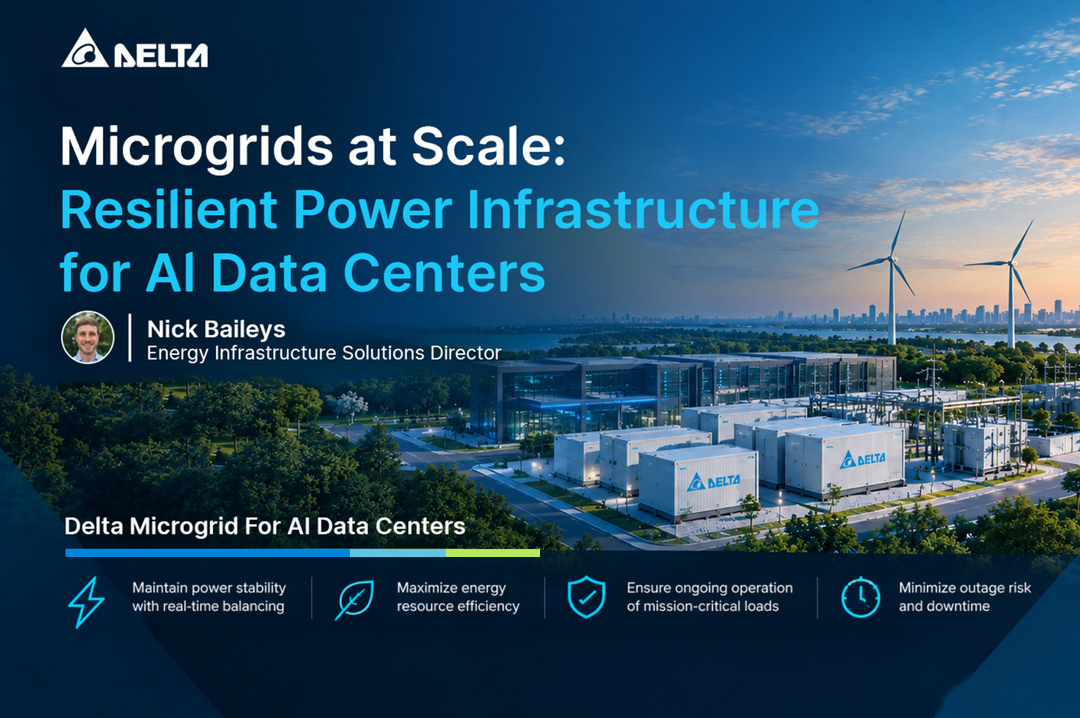
AI campuses need reliable power sooner than many grids will deliver it. Whether microgrids close that gap depends on four factors. In my Open Compute Project Global Summit 2026 session, I walked the audience through each one:
- Power sources: Firm and intermittent sources each carry a trade-off.
- Energy storage: Batteries sit at the center and absorb load swings.
- The grid and load interface: This factor matters most in planning.
- Controls: This factor has the biggest impact over the plant’s life.
A quick definition: A microgrid is a group of connected loads and distributed energy resources that serves a local area, such as a data center campus, and connects to the grid as a single controllable entity. It runs grid connected or islanded, on one source or many. (Want to dive deep into all things microgrid? Visit our microgrid microsite.)
Factor 1: Firm and Intermittent Energy Sources Each Carry a Trade-Off
Firm energy sources deliver dependable power no matter the time of day, weather, or consumer demand, while intermittent sources often deliver the lowest-cost, cleanest energy but demand careful design and balancing.
Natural gas and diesel generators lead the firm group but generate higher emissions. Solid oxide fuel cells are a cleaner alternative now gaining market traction; we’re developing our own. Solar and wind contribute to clean power that’s available around the clock, but only when you properly design, control, and balance them against other technologies.
Factor 2: Batteries Sit at the Center and Absorb the Swings
A battery energy storage system at the microgrid’s center buffers the mismatch between fast load swings and slower generation. Rising rack power drives larger, faster swings on the load side, while firm sources work best on a second-to-minute time scale. Power electronics absorb those swings at the subsecond scale. Lithium batteries connected through advanced power electronics solve much of that problem, and their value grows alongside rack power.
Factor 3: The Grid and Load Interface Matters Most in Planning
Every plan starts with whether grid power will meet your objectives, and increasingly it won’t: sites with enough utility capacity are scarce, and timelines for getting connected are hard to predict. A solid microgrid plan reduces that risk and gives you a credible fallback.
Factor 4: Controls Have the Biggest Impact Over the Plant’s Life
Controls have the biggest impact over a microgrid’s life, because the control problem grows exponentially as loads and sources multiply. Rack power, density, and load swings keep rising while loads become less controllable, and intermittent and firm sources interact in their own ways.
Take a lesson from utilities: understand worst-case scenarios in depth, and use modeling to validate recovery. Utilities have nearly a century’s experience, yet outages still happen. (During most of them, the grid is likely working as designed, isolating a fault near its origin and protecting the rest.) Pair that worst-case view with deep steady-state knowledge and validate both with models, which form the foundation of a solid microgrid platform.
Controls Act as the Plant’s Brain
Every microgrid is unique, and the controls determine whether it meets customer objectives. They hold a working-level, subsecond system view and send commands across the plant continuously. They balance supply and demand, regulate voltage and frequency, and prioritize sources against secondary goals such as maximizing solar self-consumption. They also rank loads and route power to the most critical ones. Economic dispatch, forecasting, protection, recovery, and fault isolation complete the function.
Power System Studies Turn a Concept Into a Plan
Customers come to us with either a spec or a concept; either way, my team accelerates their time to power. Some customers want our 5 MW, 34.5 kV string power conversion system (PCS) for its high availability and 20-week lead time. Others bring a concept that needs maturing.
We run power system studies to turn those concepts into plans. We review site conditions, constraints, and available resources, and evaluate the loads and what it takes to power them reliably. We then propose architectures that combine firm and intermittent sources, battery storage or other technologies, and the redundancy necessary to meet your uptime goals.
A Reference Architecture Puts the Four Factors to Work
A simplified AI data center microgrid shows all four factors at work, smoothing load swings at the rack before they reach the medium-voltage bus. A solid-state transformer (SST) converts medium-voltage AC to 800 VDC for compute and AI loads, and an isolated DC/DC converter backed by supercapacitors and energy storage absorbs swings right where they start. Mechanical support and traditional compute loads stay on standard 480 VAC distribution, which operators keep in place or evolve over time.
At the center, a two- to four-hour lithium iron phosphate (LFP) battery system connects through our PCS to the medium-voltage bus. Its job is to balance load-side swings while respecting generation-side constraints such as ramp rate limits. On the source side, solid oxide fuel cells supply firm power.
Delta’s Power Electronics Depth Fits the Control Problem
A microgrid delivers its benefits only when it does a good job controlling its inverter-based resources. Power electronics are among the fastest-acting components in a microgrid; Delta brings more than 4,000 power electronics engineers globally to that task, working across racks, thermals, PCSs, solar inverters, SSTs, and central UPSs. That breadth positions us to solve grid-to-rack problems.
A Detroit Demo Site Is Proving the Approach in Two Phases
We’ve built Phase 1 of a demo microgrid at our Detroit facility, home to our automotive business, to prove the approach. Phase 1 is a traditional AC microgrid that integrates solar and a natural gas turbine with battery energy storage: LFP batteries connected through our string PCS, a technology Delta pioneered. Phase 2 is a DC microgrid that adds our SST and two storage technologies, batteries and supercapacitors. We’ll open the site for live client demonstrations in spring 2027.
We’re also proving our commitment to the US market in Plano, Texas, where our facility will manufacture string PCSs and SSTs. Delta has operated for more than 50 years, with a nationwide U.S. presence since the early 1980s.
Take the Next Step
To learn more, visit the Delta microgrid microsite.
Q&A
Q: What is a microgrid?
A: A microgrid serves a local area, such as a data center campus, by connecting loads and distributed energy resources that link to the grid as a single controllable entity. It runs grid connected or islanded, on one source or many.
Q: Why are AI data centers turning to microgrids?
A: AI campuses need reliable power sooner than many grids deliver it. Sites with enough utility capacity are scarce, and grid connection timelines are hard to predict. A solid microgrid plan reduces that risk and gives operators a credible fallback.
Q: What determines whether a microgrid succeeds?
A: Four factors decide it:
- Power sources: Firm and intermittent sources each carry a trade-off.
- Energy storage: Batteries sit at the center and absorb load swings.
- The grid and load interface: This factor matters most in planning.
- Controls: This factor has the biggest impact over the plant’s life.
Q: Why does battery storage sit at the center of an AI data center microgrid?
A: Batteries buffer the mismatch between fast load swings and slower generation. Rising rack power drives larger, faster swings on the load side, while firm sources work best on a second-to-minute time scale. Lithium batteries connected through advanced power electronics absorb those swings at the subsecond scale, and their value grows alongside rack power.
Q: Why do controls matter so much over a microgrid’s life?
A: Controls act as the plant’s brain, and the control problem grows exponentially as loads and sources multiply. Controls balance supply and demand, regulate voltage and frequency, prioritize sources, and route power to the most critical loads. They also manage economic dispatch, forecasting, protection, recovery, and fault isolation. Modeling that validates both worst-case scenarios and steady-state operation forms the foundation for a solid microgrid platform.
Q: What does an AI data center microgrid architecture look like?
A: A reference architecture smooths load swings at the rack before they reach the medium-voltage bus. A solid-state transformer (SST) converts medium-voltage AC to 800 VDC for compute and AI loads, and an isolated DC/DC converter backed by supercapacitors and energy storage absorbs swings where they start. A two- to four-hour lithium iron phosphate (LFP) battery system connects through Delta’s power conversion system (PCS) to the medium-voltage bus, and solid oxide fuel cells supply firm power. Mechanical and traditional compute loads stay on standard 480 VAC distribution.
Q: How is Delta proving its microgrid approach?
A: Delta is building a two-phase demo microgrid at its Detroit facility. Phase 1, already built, is an AC microgrid that integrates solar and a natural gas turbine with LFP batteries connected through Delta’s string PCS. Phase 2 is a DC microgrid that adds an SST, batteries, and supercapacitors. The site opens for live client demonstrations in spring 2027. Delta’s Plano, Texas, facility will also manufacture string PCSs and SSTs.