
By Gary Harvey
Business Development Director, Building Solution Integrations
[3 minutes]
Welcome to the second in a series of blogs exploring the latest developments in building automation.
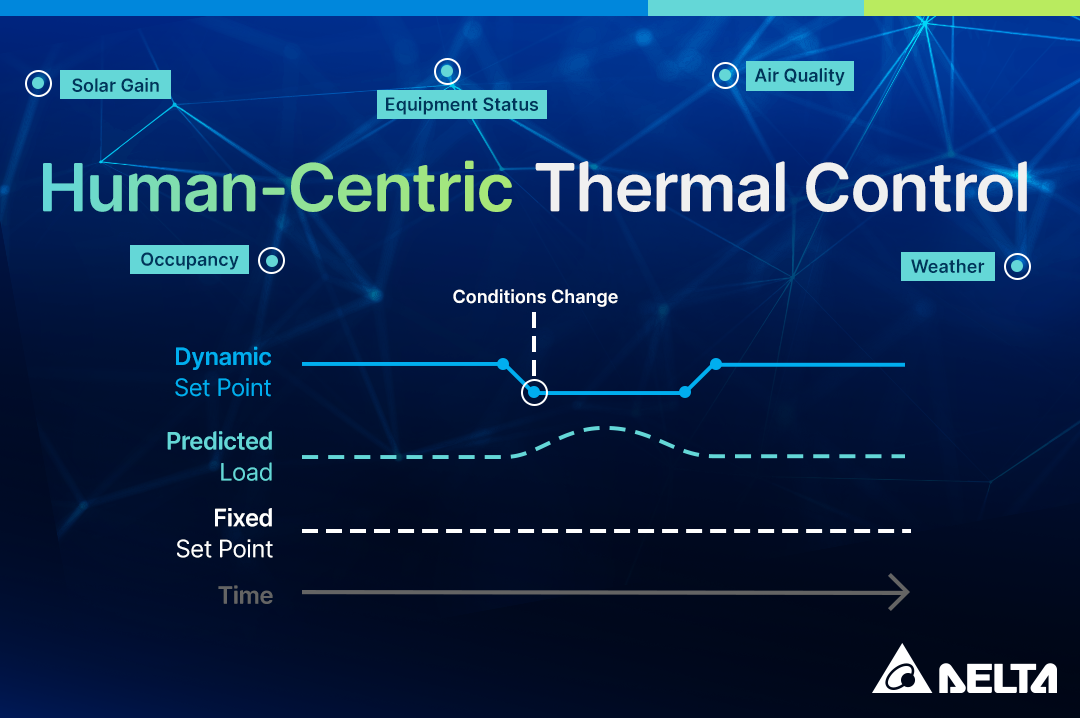
Maintaining a constant building temperature does not always create a consistently comfortable experience and it often leads to unnecessary energy use. So, today, rather than ensuring consistency for the equipment, the goal is to provide consistency for the building occupants. What makes that possible? Predictive, adaptive, connected technologies using real-time, high-quality data ingested from multiple systems.
Buildings have long been designed around a simple assumption: if a thermostat maintains a fixed temperature, occupants will remain comfortable. That philosophy shaped HVAC design, operating schedules, and building automation strategies, providing a straightforward way to manage indoor environments. But it also treated every day, every space, and every occupant the same.
Traditional HVAC systems have operated using predefined temperature targets established by facility managers or building operators. These set points were intended to provide consistent comfort while balancing equipment performance and energy consumption.
As buildings become more connected and data-rich, the industry is rethinking what thermal comfort means.
The next generation of building automation is creating environments that anticipate and continuously adapt to changing conditions and the people experiencing them. This shift toward human-centric thermal control is redefining both comfort and energy performance.
The Limits of Fixed Set Points
Fixed set points cannot account for constantly changing conditions … and buildings are anything but consistent.
Occupancy changes by the hour. Outdoor weather shifts throughout the day. Sunlight heats one side of a building while another remains shaded. Meeting rooms fill unexpectedly, hybrid work leaves office wings empty, and indoor air quality varies as people move throughout the space.
Thermal comfort has never been determined by temperature alone. Occupants experience comfort through a combination of indoor air temperature, humidity, air movement, radiant heat from surrounding surfaces, activity level, clothing, and even the number of people sharing a space. Seasonal weather patterns, changing humidity, solar gain, and equipment loads all influence how a space feels, even when the thermostat displays the exact same temperature.
The issue is not that traditional control systems are ineffective. Rather, they were designed for a world where limited data made static operation the most practical solution.
Dynamic Set Points Enable Adaptive Buildings
Today's buildings have access to far more information, enabling dynamic set points to replace static temperature targets with continuously optimized operating conditions that prevent discomfort from occurring in the first place.
Instead of defining comfort as a single number on a thermostat, intelligent building systems continuously evaluate changing conditions and adjust HVAC operation to maintain the best possible indoor environment.
This adaptive approach uses occupancy sensors, indoor environmental data, weather forecasts, equipment performance, historical operating trends, and more to respond to actual operating conditions instead of predefined assumptions.
If occupancy is expected to increase before an afternoon meeting, cooling can begin before the room becomes uncomfortable. If weather forecasts predict rapid outdoor temperature changes, HVAC operation can gradually adjust rather than reacting after conditions have already shifted. Areas of the building that remain lightly occupied can automatically operate differently than spaces experiencing heavy use.
The goal is to balance temperature, humidity, ventilation, and energy use to create healthier, more comfortable spaces while minimizing unnecessary HVAC operation.
How Intelligent Buildings Make Thermal Decisions
Collecting data is only the first step. The real value comes from how that data is interpreted, connected, and applied.
Intelligent building systems continuously gather information from various systems and then analyze how these variables interact to understand both current conditions and what is likely to happen next.
Consider a 200,000-square-foot office building on a summer morning. Weather forecasts predict outdoor temperatures climbing from 78°F to 94°F by midafternoon, increasing solar gain on the east-facing façade. At the same time, occupancy data shows several conference rooms scheduled to fill with 15 to 20 people while other workspaces remain lightly occupied.
The system anticipates how these combined factors will affect the building's thermal load and, before making any adjustments, evaluates multiple operating strategies. It may compare changing chilled water temperatures by 2°F, increasing airflow to occupied zones, adjusting ventilation rates based on indoor CO₂ levels, or temporarily relaxing cooling set points by 1 to 2 degrees in unoccupied areas. By modeling the likely impact of each approach on comfort, humidity, indoor air quality, and energy consumption, it selects the strategy that best balances occupant experience with operational efficiency.
The process doesn't end there. As conditions evolve throughout the day, the system continuously compares predicted outcomes with actual building performance and refines its control strategy as new data becomes available. Every adjustment creates additional insight, allowing the building to respond proactively rather than reactively.
Efficiency and Comfort No Longer Compete
Building owners have often viewed occupant comfort and energy efficiency as competing priorities: Improving one frequently meant sacrificing the other. Adaptive thermal control changes that relationship.
When HVAC systems condition spaces according to actual demand, equipment runs more efficiently while maintaining better indoor conditions. Unnecessary heating and cooling are reduced, equipment cycling decreases, and peak demand can often be minimized.
Instead of consuming more energy to improve comfort, intelligent control strategies help deliver both outcomes simultaneously.
Building performance is no longer defined simply by maintaining temperature but, rather, by how effectively a building responds to changing conditions while supporting occupants and reducing operational waste.
The Future Is Human-Centric
The evolution of building automation is about creating buildings that continuously learn, adapt, and improve.
As connected technologies become even more sophisticated, HVAC systems will increasingly work alongside lighting, security, occupancy analytics, energy management, and other intelligent building systems to create environments that respond to people rather than fixed schedules.
Dynamic set points represent a new operating philosophy, one where buildings continuously balance occupant comfort, operational efficiency, and sustainability using real-time intelligence instead of static assumptions.
By connecting building automation, HVAC, lighting, energy management, and IoT systems, organizations gain the real-time visibility needed to optimize comfort, improve operational efficiency, and reduce energy consumption.
The buildings of the future will not simply maintain indoor conditions. They will understand them.
Check Out the Full Digital Twin Series (So Far!)
From Reactive to Predictive, How AI Digital Twins Are Reinventing Building Automation
Automating Buildings with Digital Twins and AI Trained in a Virtual World
Digital Twins Take New Product Introduction from Trial-and-Error to First-Time-Right
Use Field Data to Create Never-Ending Manufacturing
NVIDIA Omniverse and OpenUSD Enable Digital Twins to Evolve from Connected Models to Physical Intelligence
Take the Next Step: Build Smarter, More Adaptive Facilities
Creating truly human-centric buildings begins with an integrated technology foundation.
Learn more about Delta building automation solutions. Our Intelligent Integration Services team works with building owners to create connected, intelligent environments that adapt to changing conditions and support better outcomes for both occupants and operations.
Follow us on LinkedIn
Q&A
Q: What are dynamic HVAC set points?
A: Dynamic set points automatically adjust temperature targets based on real-time conditions such as occupancy, weather, indoor air quality, and building usage rather than maintaining one fixed temperature.
Q: Why are fixed set points becoming outdated?
A: Buildings are dynamic environments. Static temperature settings cannot account for changing occupancy, weather, or operational conditions, often resulting in wasted energy and inconsistent comfort.
Q: How does human-centric thermal control improve occupant experience?
A: It continuously adapts HVAC operation to changing indoor conditions, creating more consistent comfort while reducing unnecessary heating and cooling.
Q: Do dynamic set points improve energy efficiency?
A: Yes. By conditioning spaces according to actual demand instead of fixed schedules, buildings can reduce energy waste, improve equipment performance, and lower operating costs.