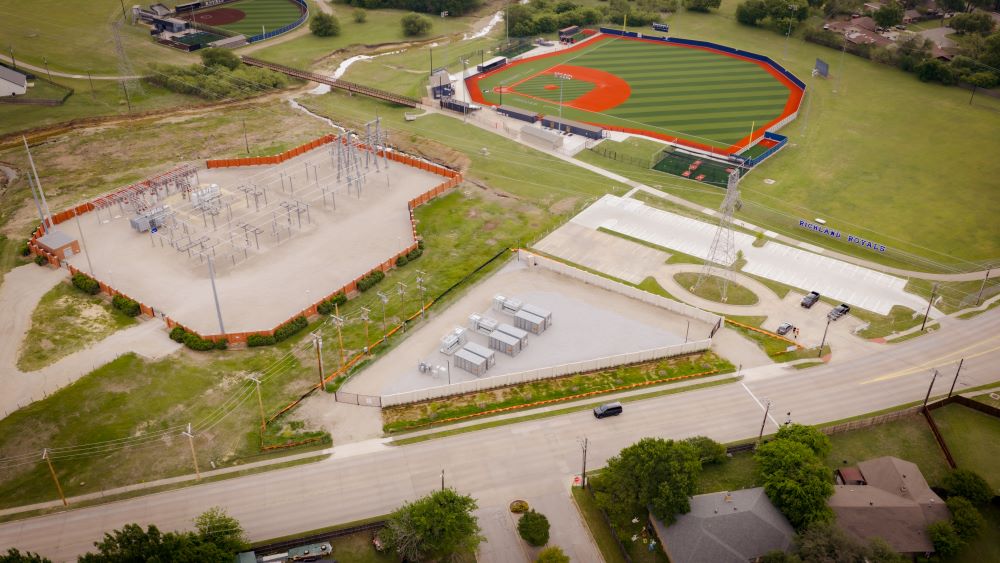
Meadow Park, a 12.9 MW / 25.8 MWh microgrid demo site commissioned in March 2026, is a live proving ground for AI data center energy solutions, operating on- and off-grid with a battery energy storage system (BESS) as the sole power asset.
AT A GLANCE
Meadow Park Components
• CleanAmps EMS Stack
• Delta PCS 4300
• Delta PCS 4300 Medium Voltage Skid
• CATL ENERC+
Environment
12.9 MW / 25.8 MWh microgrid-capable battery energy storage system designed and operated by CleanAmps
Goals
• Design, deploy, and validate a replicable on-grid/off-grid energy architecture for AI data centers
• Develop, test, and operate CleanAmps’ generation and load management systems and economic dispatch platform under evolving, real-world conditions
Results
• Demonstrated seamless on/off-grid switching under live operating conditions with integrated CleanAmps energy management system (EMS) and Delta power conversion system (PCS)
• Validated at scale a replicable blueprint for AI data center power infrastructure with CleanAmps’ generation and load management controls
• Proved Delta’s grid-forming, string PCS works reliably on- and off-grid at 12.9 MW
Download the CleanAmps Meadow Park case study (PDF)
Explore Delta Microgrid for AI Data Centers microsite
The Situation: Simple Energy Storage Is Not Enough
As grid power becomes increasingly volatile and harder to access, operators are hunting for power platforms that provide stability and resilience, and enable them to quickly implement new energy strategies.
CleanAmps, an energy consultant and renewable energy services company, designed, integrated, and now operates a 12.9 MW / 25.8 MWh BESS microgrid demo site to test which platforms best meet all the power demands of AI data centers, especially the on/off-grid voltage and frequency stability required during large (hundreds of megawatts) AI data center load swings. An outage or failure would be both extremely costly and possibly dangerous.
Meadow Park’s 12.9 MW load enables CleanAmps to validate configurations in real-world conditions before recommending them at full data-center scale.
Microgrids are self-contained energy systems able to operate independently from the utility grid, powering new data centers without their first having to wait in interconnection or transformer supply chain queues, delivering guaranteed power during utility outages, and dynamically dispatching energy from multiple sources regardless of local grid capacity. In a grid-forming BESS microgrid, battery storage serves as the primary—or only, as at Meadow Park—power asset, capable of operating both on and off the grid.
For the microgrid’s BESS hardware layer, CleanAmps selected Delta, a pioneer and leader in PCS technology, and CATL, a leading battery manufacturer. CleanAmps developed the site’s architecture including distribution infrastructure, controls software, and operational methodology.
“We see Meadow Park as a practical platform for more than core controls integration. It supports the continued development of CleanAmps’ generation management system, load management system, and a broader economic dispatch platform designed to enable automated, dynamic trading and dispatch decisions based on real-time grid conditions, asset availability, and market signals across both grid-interactive projects and microgrid applications.”
—Breck Bovin, Chief Technology Officer, CleanAmps
The Meadow Park project showcases advanced capabilities in AI infrastructure, data center energy optimization, battery storage, microgrid architecture, renewable integration, and grid-forming inverter technology.
Challenge: Proving a Power-Conversion Architecture for the AI Future
The CleanAmps design called for a largely untried power-conversion architecture: string PCS technology. String PCS-based systems, which are just now entering the commercial mainstream, offer several advantages over traditional central PCS designs.
At Meadow Park, Delta provided its PCS 4300, a modular, scalable, bidirectional, highly efficient (up to 98.7%) grid-forming PCS to store, optimize, and manage energy both on and off the grid. The 4300 offers exceptional reliability: For example, if one of the PCS 4300’s 20 modules fails, the unit still provides roughly 95% of the power available. If necessary, an onsite replacement module can be easily swapped in without heavy equipment in just hours. Integrated with a medium-voltage skid, the Delta system creates a high-performance platform suited for projects that need to quickly expand or accommodate new energy realities.
For these reasons, CleanAmps favors string PCS architecture. At Meadow Park, the company is gaining real-world data through its energy management system to further substantiate string PCS reliability.
“Delta’s string PCS architecture brings meaningful advantages for applications where resilience, modularity, and control flexibility matter. It helps reduce single-point failure exposure and provides a better framework for managing battery string imbalance, which the storage industry is increasingly recognizing as an important performance and capacity issue.”
—Breck Boven, Chief Technical Officer, CleanAmps
Solution: Smooth, On- and Off-Grid, Replicable Power
CleanAmps led every phase of Meadow Park’s design and integration, work that began well before any hardware arrived on site. CleanAmps defined the system architecture, specified string PCS over conventional central PCS designs, established the on-grid/off-grid operating requirements, and selected vendors whose equipment would meet those specs.
The company developed the site’s single-line diagrams, communications protocols, and controls hierarchy, placing its own generation and load management systems above the hardware layer. It managed permitting with the local authority having jurisdiction (AHJ)—a process that spans fire codes, interconnection agreements, and site approvals—and drove the plan that commissioned Meadow Park in an exceptionally quick two weeks.
Throughout, CleanAmps worked alongside Delta engineering teams, directing controls integration and testing the equipment. Delta customized the PCS 4300 for off-grid load smoothing and supported commissioning.
The site now functions as a permanent test bed: CleanAmps continues to simulate real-world scenarios, evaluate additional hardware combinations, and feed live operational data back into its generation and load management systems and economic dispatch platform.
Delta’s Growing Microgrid Commitment
Microgrids have become a strategic priority across the AI data center market, and Delta is investing accordingly.
Delta is bringing PCS manufacturing to Plano, Texas, with a pilot production line running by the end of 2026 and full production ramping up in 2027; this will position Delta to serve the same high-growth US market that CleanAmps is helping to define. In Raleigh, NC, Delta’s new Microgrid Technology Center gives its engineers and customers a dedicated environment for developing, testing, and optimizing microgrid architectures before they are deployed in the field. Live microgrid demonstrations are planned for Q1 2027 at Delta’s Plymouth, Michigan microgrid site, where CleanAmps and other partners can try out real-world configurations in front of customers who want to see the technology work before they commit.
Microgrids are no niche application for Delta. Rather, they are a core business line, with the R&D, manufacturing, and demonstration infrastructure to match.
“Meadow Park required more than standard equipment. We needed a partner willing to work through customization, controls integration, commissioning, and the practical challenges of deploying advanced grid-forming technology in a demanding application. Delta has been a strong partner in that process.”
—Josh Gunderson, Chief Operating Officer, CleanAmps
Conclusion: Ready for Anything
As AI data centers and other power-intensive facilities squeeze utility infrastructure, increasingly anxious owners are quickly adapting to an insufficient grid. The energy constraints facing AI data centers are engineering problems, not permanent limits. An owner-operator with the right architecture, software, and partners can solve them at scale.
CleanAmps designed the Meadow Park system, built the controls stack, managed the integration, and led the site commissioning. The BESS hardware—Delta’s PCS and CATL’s batteries—proved to be an excellent fit for the on-grid/off-grid architecture work. Beyond demonstrating mere technical capability, Meadow Park proves a hybrid (on-grid/off-grid) BESS microgrid offers the flexibility and scalability required by our distributed energy future.
The result is a validated, repeatable blueprint for powering AI data centers that is well positioned to propagate throughout the industry.
