
By Gary Harvey
Business Development Director, Building Solution Integrations
[3 minutes]
Welcome to the third in a series of blogs exploring the latest developments in building automation.
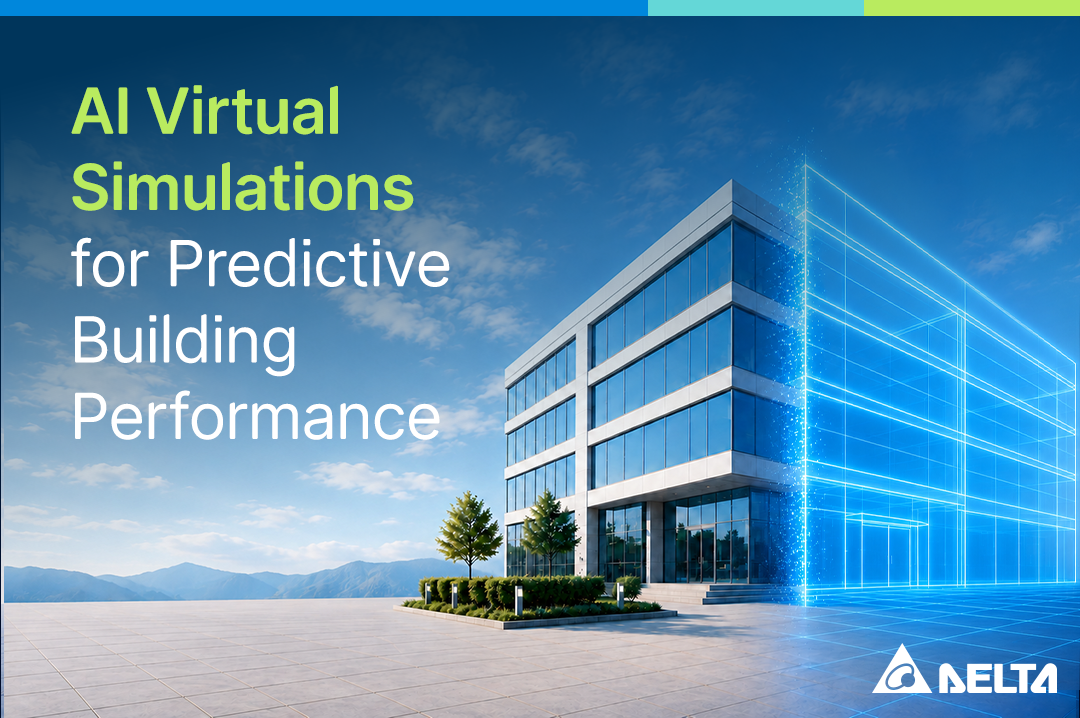
Before an AI system can make decisions in a real building, it needs to learn how that building behaves.
But training an AI model in a physical environment can be slow, expensive, and disruptive. That’s because real buildings are complex, dynamic environments. The temperature changes throughout the day. Occupancy fluctuates. Equipment behaves differently under varying conditions. Lighting, HVAC, security, and other systems interact in ways that are difficult to predict.
And real buildings contain real people.
So what if instead of learning through trial and error in a physical building, AI could first learn through simulation in a virtual world?
Creating a Digital Environment for AI
Digital twins provide a way to create a virtual representation of a physical building and its systems. Instead of waiting for an event to happen in the real world, building operators can use AI models in a digital environment to simulate thousands of scenarios.
For example, virtual buildings can incorporate information about equipment, environmental conditions, occupancy, energy consumption, and system performance. As data is collected, the model becomes increasingly representative of how the physical building operates.
Give an AI model a scenario such as an unexpected increase in occupancy, and it's able to evaluate how that change affects temperature, indoor air quality, energy consumption, equipment performance, and more, as well as testing different responses and compare the outcomes.
Learning Without the Risk
Virtual training enables building operators to test situations that may be difficult, expensive, or unsafe to reproduce in the real world.
Consider preparing for a major event in a commercial building. Hundreds of additional occupants may arrive within a short period of time. That sudden increase creates extra demand on HVAC systems, lighting, elevators, and other building infrastructure.
In a physical building, operators may only discover limitations when the event actually occurs.
In a virtual environment, AI can run different scenarios, adjust variables, and observe how the building responds. What happens if occupancy increases by 20 percent? What if outdoor temperatures rise significantly? What if an HVAC unit becomes unavailable? What combination of temperature set points and equipment schedules provides the best balance between occupant comfort and energy consumption? AI can test these scenarios repeatedly, within seconds, without disrupting anything (or anyone) in the physical world.
From Reactive AI to Predictive Intelligence
AI enables building operators to anticipate those conditions before they occur. This shift from reactive control to predictive intelligence leads buildings to become more efficient, responsive, and resilient.
Traditional building automation is largely designed to respond. A sensor detects that a room is too warm, for example, and the system responds by adjusting the HVAC equipment.
A digital twin that combines historical building data with real-time information and simulated scenarios can identify patterns and determine how different decisions will influence future conditions.
For example, an AI model could recognize that occupancy is increasing, or the outdoor temperatures are rising, and know that the room historically experiences a temperature increase under similar conditions. The system could then take steps before temperature becomes a problem.
The Virtual World Becomes a Training Ground
The value of simulation extends beyond individual scenarios as AI can ingest years' worth of building conditions within a fraction of the time.
By exposing a model to seasonal changes, varying occupancy patterns, equipment failures, energy constraints, and other conditions, each scenario becomes another opportunity for the AI to learn how the building responds.
This also enables AI models to continually improve, incorporating newly available information from the physical building into the digital environment. The updated virtual model can then be used to test new strategies and evaluate potential outcomes before implementing them.
The result is a continuous feedback loop between the physical and virtual environments.
The building provides data. The digital twin provides the environment. AI provides intelligence.
Building Smarter Before Building Changes
Virtual training changes how we approach building optimization.
Instead of asking, "What should the building do right now?" Building teams can begin by asking, "What could happen next, and how should the building respond?"
As buildings become increasingly connected, the volume of available data will continue to grow. Sensors, building management systems, lighting controls, security systems, and other technologies provide increasingly detailed information about how a space operates.
AI turns that information into actionable insight, while digital twins provide a controlled environment for testing those insights.
The Future of Intelligent Buildings
The future of smart buildings is likely to involve two environments operating together: the physical building where people live and work, and the virtual building where AI learns what to do next, creating a truly autonomous building.
By combining digital twins, building data, simulation, and machine learning, AI can learn in a virtual environment and then bring those insights into the physical building.
This approach will make intelligent buildings more predictive, adaptive, and efficient while reducing the risks associated with testing new strategies in occupied spaces.
Take the Next Step ... with Delta Electronics
As intelligent building technologies continue to evolve, the ability to connect real-world building systems with data-driven digital environments will become increasingly important.
Delta Electronics brings together building automation, lighting, sensing, energy storage and management and integration technologies to help create connected environments that are ready for the next generation of intelligent building solutions.
Follow us on LinkedIn
Q&A
Q: Why can't AI just learn directly in a real building?
A: Physical buildings are too slow, costly, and disruptive to serve as a training ground. Temperature, occupancy, and equipment behavior shift constantly, making real-world trial-and-error impractical for teaching an AI system how a building actually behaves.
Q: What role do digital twins play in AI training?
A: Digital twins give AI a virtual building to learn in. They combine equipment data, environmental conditions, occupancy, and performance history, letting operators simulate thousands of scenarios without touching the physical building.
Q: What kinds of scenarios can be tested virtually?
A: Anything difficult or risky to reproduce live — a sudden 20% occupancy spike, rising outdoor temperatures, or an HVAC unit going offline. AI can run these repeatedly within seconds to find the best response.
Q: How does this shift AI from reactive to predictive?
A: Digital twins let AI recognize patterns before problems occur, rather than responding after the fact. Instead of adjusting HVAC once a room feels warm, the system anticipates the temperature rise and acts ahead of it.
Q: How much can AI actually learn through simulation?
A: A digital twin can compress years of building conditions — seasonal shifts, occupancy patterns, equipment failures — into a fraction of the real time, giving AI far more training exposure than physical operation alone allows.
Q: How do the physical and virtual environments work together?
A: They form a continuous feedback loop. The physical building supplies real data, the digital twin provides a testing environment, and AI turns both into decisions — each side improving the other over time.
Q: What's the bigger shift this enables for building teams?
A: Teams move from asking "What should the building do right now?" to "What could happen next?" That forward-looking approach changes building optimization from a reactive task into a predictive discipline.
Q: What does this mean for the future of smart buildings?
A: Truly autonomous buildings will likely run on two connected environments — the physical space people occupy, and a virtual space where AI continuously learns and refines what to do next