
By Laurence Mu
Account Manage, Omniverse, Infrastructure Account Management
Roshelle Fondeur
Marketing Specialist, Building Solution Integrations
[4 minute read]
Welcome to the fifth in a series of blogs exploring Delta's DIATwin™ digital twin's inner workings and outer benefits.
A digital twin, as you may already know, is more than a 3D representation of a physical environment. Its greater potential lies in connecting digital models with real-world data, simulation, and intelligence, enabling organizations to better understand and optimize how complex environments operate.
Today, engineering teams rely on specialized platforms—including Delta’s own DIATwin and tools from companies such as SolidWorks, Autodesk, ANSYS—to design, model, and simulate different aspects of a facility or factory. Each provides valuable capabilities but, when used in isolation, can create disconnected workflows, duplicated data, and inconsistencies between models and simulations.
Connecting these digital models gives organizations a full digital representation of the physical world. Technologies such as OpenUSD and NVIDIA Omniverse™ provide an important foundation for that evolution.
OpenUSD offers a common data framework for bringing information from different sources into a shared digital environment, while NVIDIA Omniverse builds on connected data with capabilities for 3D visualization, collaboration, and physics-based simulation.
But connecting the models is only the beginning.
From Disconnected Models to a Shared Digital Environment
A modern factory or building may be represented across many digital systems, for example …
An engineering platform may contain detailed information about a physical component. An architectural model may describe the structure and spatial relationships of a facility. A simulation environment may evaluate how systems behave under specific conditions.
A digital twin platform combines these different sources to provide a broader representation of the physical environment. The challenge is connecting these sources so that information is useful beyond the individual system in which it was created.
OpenUSD provides a framework for organizing and describing complex 3D scenes and bringing disparate sources into a shared environment in which the connected data contributes to a broader digital representation.
Then a digital twin is able to bring together information across the design, engineering, simulation, and operational lifecycle.
NVIDIA Omniverse builds on this connected foundation, providing an environment for visualization, collaboration, and physics-based simulation.
The result is not simply a collection of 3D models. It is a digital environment with greater context around how the physical environment is designed and how its different components relate to one another.
The Digital Twin Meets the Physical World
A digital twin becomes even more valuable when it reflects what is actually happening in the physical environment.
Real-time information from factory equipment, building systems, sensors, and other connected technologies provide insight into current operating conditions. Bringing this information into the digital environment enables the digital twin to better represent the facility or factory as it actually operates.
For example, a building digital twin could incorporate a range of information—such as occupancy, temperature, environmental, equipment performance, and energy consumption—and consider them together within the physical environment to create a more dynamic relationship between the digital and physical worlds.
That connection is where the digital twin moves beyond visualization.
From Visualization to Simulation
High-quality 3D visualization remains an important part of a digital twin, providing a way to understand complex physical environments and the relationships between systems.
But visualization alone does not answer a more important question: What happens if we change something? This is where simulation becomes critical.
Instead of relying entirely on physical trial and error, organizations use physics-based models to evaluate different scenarios and explore potential outcomes in a digital environment, before implementing changes in the physical world.
For a factory, this could involve evaluating equipment behavior, production conditions, or changes to a physical layout.
For a building, it could involve examining how changes in occupancy, environmental conditions, equipment operation, or system settings could affect performance.
The digital twin therefore becomes more than a digital copy. It becomes a place to test possibilities before acting on them.
Adding AI and Physical Intelligence
The next step is adding intelligence.
AI analyzes large amounts of operational information, enabling it to identify patterns, recognize changing conditions, and surface opportunities that may not be immediately apparent from individual data sources.
When AI is combined with physics-based simulation, the digital twin becomes a platform for evaluating not only what is happening, but what could happen next.
This is where the concept of physical AI becomes increasingly important.
Physical AI is applied to environments governed by physical systems and conditions, working with information about equipment, spaces, environmental conditions, movement, and system behavior.
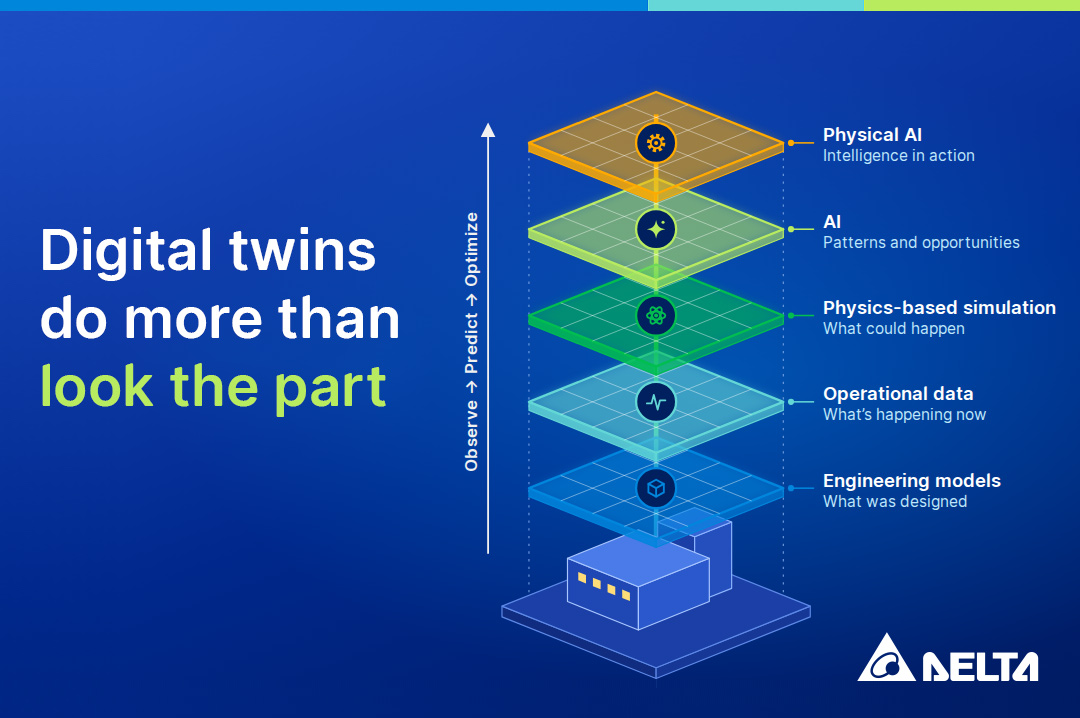
Within a digital twin, this enables organizations to combine:
- Engineering models to understand what has been designed
- Operational data to understand current conditions
- Physics-based simulation to evaluate potential outcomes
- AI to identify patterns and opportunities
- Physical AI to connect digital intelligence with physical environments
Together, these capabilities empower organizations to move from simply observing an environment toward predicting, optimizing, and improving its performance.
The physical environment generates data. The digital twin provides context. Simulation evaluates possibilities. AI identifies opportunities.
From Insight to Operational Action
The ultimate opportunity is to connect the digital twin and the systems responsible for operating in the physical environment.
Consider a connected building. Real-time operational data could be brought into a digital twin, where AI analyzes occupancy, environmental conditions, equipment performance, and energy use. The system identifies an opportunity to optimize performance and uses simulation to evaluate potential changes before they are implemented.
In more advanced implementations, optimization recommendations could translate into control actions through a building management system such as Delta's enteliWEB platform.
This creates the possibility of a continuous feedback loop:
Physical Environment → Operational Data → Digital Twin → Simulation → AI → Optimization → Operational Action
The objective is to create a digital environment that gives people and operational systems better information for understanding what is happening, evaluating what could happen, and determining what action(s) to take.
Where Business Value Emerges
Digital twins are evolving from representation toward intelligence.
A digital twin does not operate in isolation. Its value increases when it connects engineering information, operational systems, real-time data, simulation capabilities, and intelligent applications into a broader solution.
For organizations managing complex physical environments, this creates an opportunity to approach digital transformation differently.
Think: “What can we do with the digital twin once it is connected to our physical operations?”
DIATwin and SolidWorks, Autodesk, and ANSYS tools are able to provide specialized information across the engineering and digital lifecycle. OpenUSD establishes a common framework for connecting information from different sources. NVIDIA Omniverse provides an environment for bringing that connected data together for visualization, collaboration, and physics-based simulation.
From there, real-time operational data connects the virtual environment to actual conditions in a factory or building. AI and physical AI add another layer of intelligence, enabling organizations to analyze those conditions, simulate potential outcomes, and identify opportunities for optimization.
The result is a digital twin that does more than represent the physical world. It becomes a platform for understanding it, testing possibilities within it, and using intelligence to improve what happens in the physical environment.
The future of the digital twin is a connected, intelligent environment where models, operational data, simulation, and AI work together to help organizations make better-informed decisions and improve real-world performance.
Check Out the Full Digital Twin Series (So Far!)
From Reactive to Predictive, How AI Digital Twins Are Reinventing Building Automation
Human-Centric Thermal Control, Brought to You by Connected, Real-Time Intelligence
Automating Buildings with Digital Twins and AI Trained in a Virtual World
Digital Twins Take New Product Introduction from Trial-and-Error to First-Time-Right
Use Field Data to Create Never-Ending Manufacturing
Take the Next Step
Check out Delta's full range of industry-leading
Industrial Automation Solutions.
Q&A
Q: What is the next evolution of the digital twin?
A: The digital twin is becoming a connected, intelligent environment where engineering models, operational data, simulation, and AI work together. Instead of just representing a facility or factory, the digital twin becomes a platform for understanding that environment, testing possibilities within it, and improving real-world performance.
Q: How do disconnected digital models create problems?
A: Isolated models lead to disconnected workflows, duplicated data, and inconsistencies between models and simulations. When engineering teams rely on specialized platforms (such as Delta's DIATwin and tools from SolidWorks, Autodesk, and ANSYS) that are siloed, their information stays useful only inside the system that created it.
Q: How do OpenUSD and NVIDIA Omniverse connect these models?
A: OpenUSD provides the common data framework, and NVIDIA Omniverse builds on it with visualization, collaboration, and physics-based simulation. OpenUSD organizes and describes complex 3D scenes, bringing disparate sources into one shared environment. Omniverse then turns that connected data into a working environment.
Q: What role does real-time operational data play in a digital twin?
A: Real-time data makes the digital twin reflect how a facility actually operates, not just how it was designed. A building digital twin, for example, could combine occupancy, temperature, equipment performance, and energy consumption to create a dynamic link between the digital and physical worlds.
Q: How do simulation, AI, and physical AI change what a digital twin does?
A: Together they move organizations from observing an environment toward predicting, optimizing, and improving its performance. Physics-based simulation answers "What happens if we change something?" by testing scenarios digitally before anyone makes physical changes. AI analyzes large volumes of operational data to surface patterns and opportunities. Physical AI applies that intelligence to environments governed by physical systems.
Q: How does a digital twin turn insight into operational action?
A: The digital twin connects to the systems that operate the physical environment, creating a continuous feedback loop. In a connected building, AI analyzes real-time data, identifies an optimization opportunity, and uses simulation to evaluate changes before implementation. In more advanced implementations, those recommendations could translate into control actions through a building management system such as Delta's enteliWEB platform. The loop runs: Physical Environment → Operational Data → Digital Twin → Simulation → AI → Optimization → Operational Action.