8/12/2026
Why Midsize Data Centers Need to Punch Above Their Weight—Blog #10 in a Series

By Brooks Vaughan
Sr. Product Marketing Manager
[3 mins]
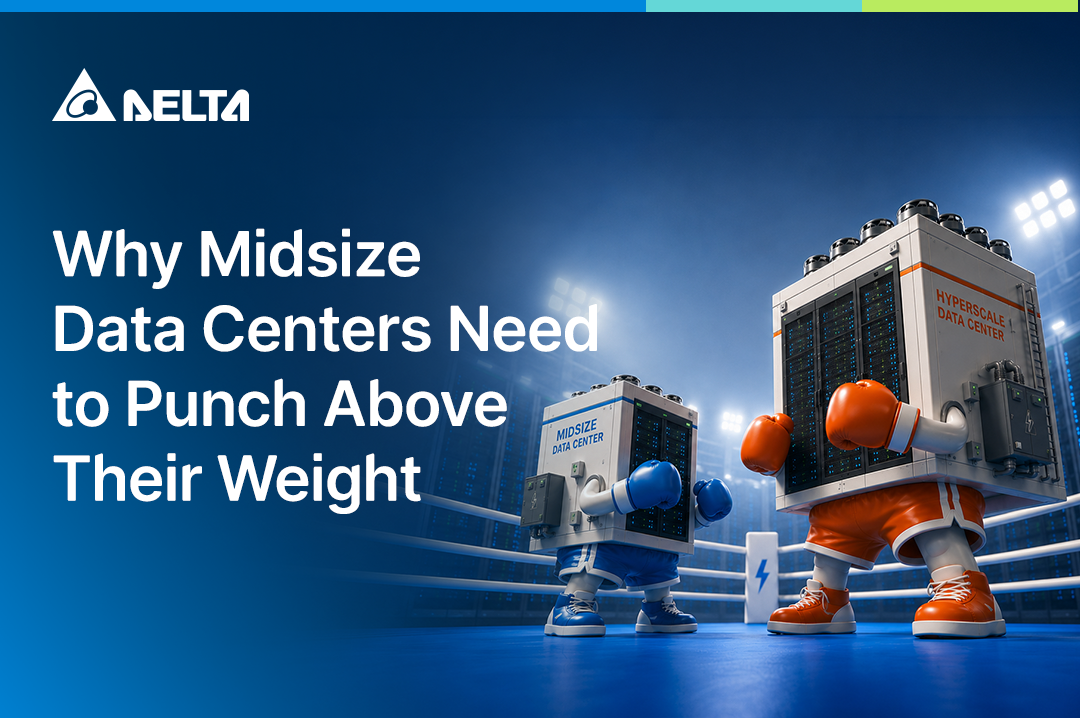
In the tenth blog in our “Rise of the AI Data Center” series, inspired by our latest white paper, we turn our attention to issues and opportunities faced by data centers in the 5-30 megawatt range. Hyperscalers get most of the attention and, it's true, most of the advantages—but that doesn't mean all that's left is scraps.
We decided to mix up the format for this piece, lobbing questions at Brooks Vaughan, a Delta Sr. Product Marketing Manager. Our questions and his answers below.
Q: Why are 5-30 MW operators uniquely challenged compared to hyperscalers? What trends contribute to them being less insulated than hyperscalers?
A: Hyperscalers and 5 to 30 MW operators are not playing the same game, even though the trade press talks as if they are. The difference comes down to leverage over three scarce inputs: power, electrical equipment, and accelerators.
A hyperscaler negotiates utility tariffs and power contracts bilaterally at gigawatt scale, places volume equipment orders years ahead, and reserves GPU allocation before anyone else gets a look. A smaller operator does none of that from a position of strength. Grid interconnection now runs five to seven years in the markets in which people actually want to build, large transformers are past two year lead times, and most of NVIDIA's Blackwell supply was spoken for through 2026 and 2027 before the midmarket could place an order.
Also, smaller operators frequently lack deep, in-house architecture expertise, so they turn to infrastructure partners such as Delta to guide them toward the right design. Even well-staffed teams, often led by engineers who came from a hyperscaler, still value outside input on architecture decisions.
Q: What mistakes do you see these operators making most frequently when preparing for AI workloads?
A: The most expensive mistake we see is when operators treat AI as an incremental upgrade to an existing facility rather than an architectural break. The jump from a 12 to 40 kW air-cooled rack to a 120 kW liquid-cooled one is not a bigger version of the same thing; it changes the power and cooling design from the ground up. Operators who bolt AI onto a legacy floor plan end up retrofitting twice.
Q: Have these challenges changed significantly over the past 12 to 18 months?
A: The big change over the last 12 to 18 months is that data center procurement got both harder and more expensive all at once. Three things compounded: Power and cooling equipment lead times got longer, prices on that same gear went up, and power availability tightened until it became the constraint that gates everything else. Put those together and you get a frenzy. Operators are ordering earlier, paying more, and still waiting longer, while the biggest buyers sit at the front of every queue.
Underneath that procurement squeeze is a demand shock. Rack density rose from roughly 40 kW to 120 kW in about two years and is pointed toward 600 kW to 1 MW by 2027, which made liquid cooling mandatory rather than nice to have and sent cooling demand through the roof against a supply base that cannot expand fast enough. Transformers, switchgear, UPS, and now liquid-cooling gear are all caught in the same crunch. The hyperscalers saw it coming and locked in chip and equipment purchases on forward contracts. The midmarket is largely reacting to the scarcity they left behind and paying a premium to do it.
Q: Where are midsize operators most likely to waste capital in the next 12 to 24 months?
A: Over the next 12 to 24 months, the fastest way for a midsize operator to waste capital is to make an irreversible bet in a market that is still moving. Betting heavily on one cooling architecture is the clearest example. Pour money into fixed-air cooling as densities cross 50 kW, or commit to a single direct to chip design just as 800 VDC and the next density step arrive in 2027, and you own a stranded asset.
Q: What would the industry misunderstand if it looked at AI infrastructure only through a hyperscale lens?
A: If you look at AI infrastructure through a hyperscale-only lens, you misread the market the midmarket actually serves. The headline story is gigawatt training campuses, but most enterprises are going to consume AI, not train frontier models—and consumption means inference. Inference runs at 10 to 50 kW per rack, it follows users, and it is latency sensitive, which makes it a natural fit for distributed 2 to 8 MW facilities near population centers rather than one enormous campus in the middle of nowhere.
Take the Next Step
The “Rise of the AI Data Center” white paper lays out a strategic framework as "a new normal for power." Read the white paper
Want to see how much your data center could save with only minor improvements in efficiency? Check out our Power Efficiency Savings Calculator
Here's the full "The Rise of the AI Data Center" blog series:
Follow us on LinkedIn
News Source:Delta Electronics (Americas) Ltd.