
By Alex Liu
ESG Manager, Americas Region
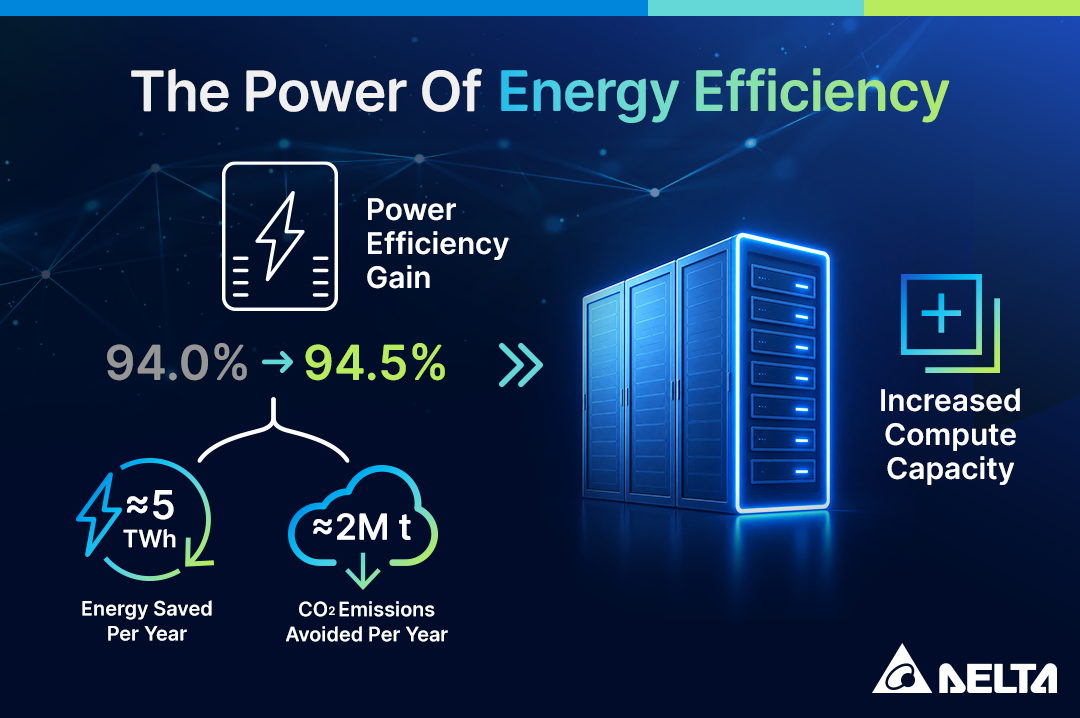
Why is improving energy efficiency one of the fastest and most cost-effective ways to reduce global carbon emissions—and, not coincidentally, reduce an organization’s costs? No power supply is 100% efficient so there is unavoidable energy loss, usually as heat, as electricity feeds electronics. When compounded on a global scale, those small, wasteful interactions roll up significantly.
Now consider that the rapid growth in data center capacity driven by digitalization and artificial intelligence is projected to boost global data center electricity consumption to about 945 TWh annually by 2030—roughly double what it was in 2025.
To highlight how even tiny efficiency gains will have an outsize, positive impact at this scale, we need to do a little math.
Small Efficiency Gains, Massive Global Impact
If average power supply efficiency improves just 0.5 percent—say, from 94.0% to 94.5%—industry would reduce data center electricity consumption by roughly 5 TWh per year!
The cost savings would be enormous, as would the environmental benefit: A 5 TWh reduction in electricity consumption cuts out about 2 million metric tons of CO₂ emissions ... every year. CO₂ is a powerful greenhouse gas.
You see why high-efficiency power infrastructure is now a critical enabler of sustainable growth in the AI era. Organizations that rely on high-efficiency power supplies simultaneously lower operating costs, reduce energy waste, and shrink their carbon footprint—all without compromising performance.
Energy Saved = Compute Power Gained
Every watt saved through higher-efficiency power conversion can be redirected to productive computing rather than being lost as heat. As a result, organizations can effectively achieve more AI processing power from the same energy budget and infrastructure footprint.
In essence, energy efficiency creates a multiplier effect: it enables greater AI performance with fewer resources, reduces the need for additional power generation, and accelerates progress toward sustainability goals.
One of the most significant constraints on future computing growth is the availability of electrical power. Around the world, data center operators are facing increasing challenges in securing sufficient energy capacity to support rapidly expanding AI workloads. In many regions, power availability and grid constraints have become the major limiting factors determining how much new computing infrastructure can be deployed.
This reality makes energy efficiency far more than an operational consideration; it’s now a strategic lever for unlocking additional AI computing capacity.
Energy Efficiency’s Global Ripple Effects
By adopting advanced high-efficiency power supplies, companies can reduce energy waste, lower operating costs, and shrink their carbon footprint while simultaneously expanding their computational capabilities.
The benefits extend far beyond individual enterprises. Energy efficiency has the power to transform entire organizations and cities.
For organizations, reduced power consumption means lower operating expenses, greater resilience against rising energy costs, and stronger progress toward environmental, social, and governance (ESG) commitments.
For cities and regions, however, energy efficiency is increasingly becoming a necessity rather than simply a sustainability goal. The rapid expansion of AI-driven data centers has sparked growing concerns over electricity demand, grid capacity, and water consumption.
In Utah, state leaders have raised concerns about the impact of large-scale data center developments on energy infrastructure, utility rates, water resources, and local communities as major projects continue to expand across the state.
Meanwhile, New York implemented the nation's first statewide one-year moratorium on new hyperscale data centers in 2026 while regulators develop stronger standards to address concerns about grid reliability, environmental impacts, and potential increases in electricity costs for residents.
These examples demonstrate that the challenge is no longer whether digital infrastructure is needed, but how it can grow sustainably. This is where innovation plays a critical role.
Take the Next Step … with Delta Electronics
Delta is proving that powerful and practical innovation can drive both efficiency and sustainability without sacrificing one another.
As data center operators seek to meet both sustainability targets and growing compute demands, Delta is doing its part to save energy/lower costs and reduce carbon on a global scale. In fact, Delta has already enabled our customers to save more than 6.5 TWh of energy in a single year!
The next step is clear: organizations should treat energy efficiency as a strategic investment rather than a technical afterthought. By evaluating power infrastructure and adopting higher-efficiency technologies, businesses can unlock immediate energy savings while supporting long-term sustainability goals. As AI and digital transformation continue to accelerate, every incremental efficiency gain will help build a more sustainable future for organizations, cities, and the world.
Q&A
Q: Why does energy efficiency matter so much for data centers right now?
A: Energy efficiency ranks among the fastest, most cost-effective levers for cutting global carbon emissions. No power supply converts electricity at 100% efficiency, so every conversion loses some energy as heat. Multiplied across a global data center fleet, those small losses roll up into a massive impact.
Q: How fast is data center electricity demand growing?
A: Global data center electricity consumption is projected to reach about 945 TWh annually by 2030, roughly double 2025 levels. Digitalization and AI workloads drive most of that growth.
Q: How much impact can a small efficiency gain deliver?
A: A 0.5 percentage point improvement in average power supply efficiency, from 94.0% to 94.5%, cuts data center electricity consumption by roughly 5 TWh per year. That reduction removes about 2 million metric tons of CO₂ emissions annually, a meaningful dent given CO₂'s outsize role as a greenhouse gas.
Q: Does higher efficiency actually translate into more usable compute power?
A: Yes: every watt saved through higher-efficiency power conversion gets redirected to productive computing instead of being lost as heat. Organizations gain more AI processing power from the same energy budget and infrastructure footprint.
Q: Why has power availability become a bottleneck for AI growth?
A: Grid constraints and limited energy capacity now rank among the top factors capping how much new computing infrastructure operators can deploy. This shortage elevates energy efficiency from an operational detail to a strategic lever that unlocks additional AI computing capacity.
Q: What ripple effects does energy efficiency create beyond a single company?
A: Energy efficiency benefits extend from individual organizations to entire cities and regions. Companies gain lower operating expenses, greater resilience against rising energy costs, and stronger progress toward ESG commitments. Cities and regions gain relief on grid capacity, water consumption, and electricity demand pressures.
Q: What is Delta doing to address this challenge?
A: Delta has already enabled customers to save more than 6.5 TWh of energy in a single year. High-efficiency power infrastructure now stands as a key enabler of sustainable growth in the AI era, and Delta's technology proves that efficiency and sustainability can advance together without sacrificing performance.
Q: What's the next step for organizations evaluating their power infrastructure?
A: Organizations should treat energy efficiency as a strategic investment rather than a technical afterthought. Evaluating power infrastructure and adopting higher-efficiency technologies unlocks immediate energy savings while supporting long-term sustainability goals as AI and digital transformation accelerate.